IGCSE revision videos, one sub-topic at a time.
Dedicated, in-depth videos that follow the Cambridge syllabus sub-topic by sub-topic, for IGCSE Business, IGCSE Accounting, IGCSE Economics, IGCSE Mathematics, IGCSE Biology, IGCSE Chemistry and IGCSE Physics, plus A Level Physics. Each has captions and a transcript, and leads straight on to practice.
Topic-wise, in depth · captions on every one
 14:56
IGCSE Biology · 9.2
Heart
 10:38
IGCSE Mathematics · 6.2
Right-angled triangles
 14:31
IGCSE Physics · 3.2
Light
 19:09
A Level Physics · 17.1
Simple harmonic oscillations
How they work
Watch the idea, then use it straight away.
One sub-topic per video
Each video is a single sub-topic, with the same number and title as in the syllabus, so you can find exactly the bit you need.
Captions and a transcript
Turn subtitles on or off. The transcript runs underneath the player, and clicking a line jumps the video to that moment.
Ask about the bit you're stuck on
Pause and ask about the moment you're at, or tap “Explain the last bit”. The AI tutor knows which video you're on and how far in you are.
Picks up where you stopped
Leave halfway and the video starts from the same place next time on that device. Watched ones are ticked off.
Only your subjects, only your level
You see the subjects on your profile. Topics outside your level are hidden, so an AS student doesn't get A Level videos.
A next step, not a dead end
After a video, practise past-paper questions on the same topic, get quizzed on it, or rate the chapter in your planner.
What it looks like
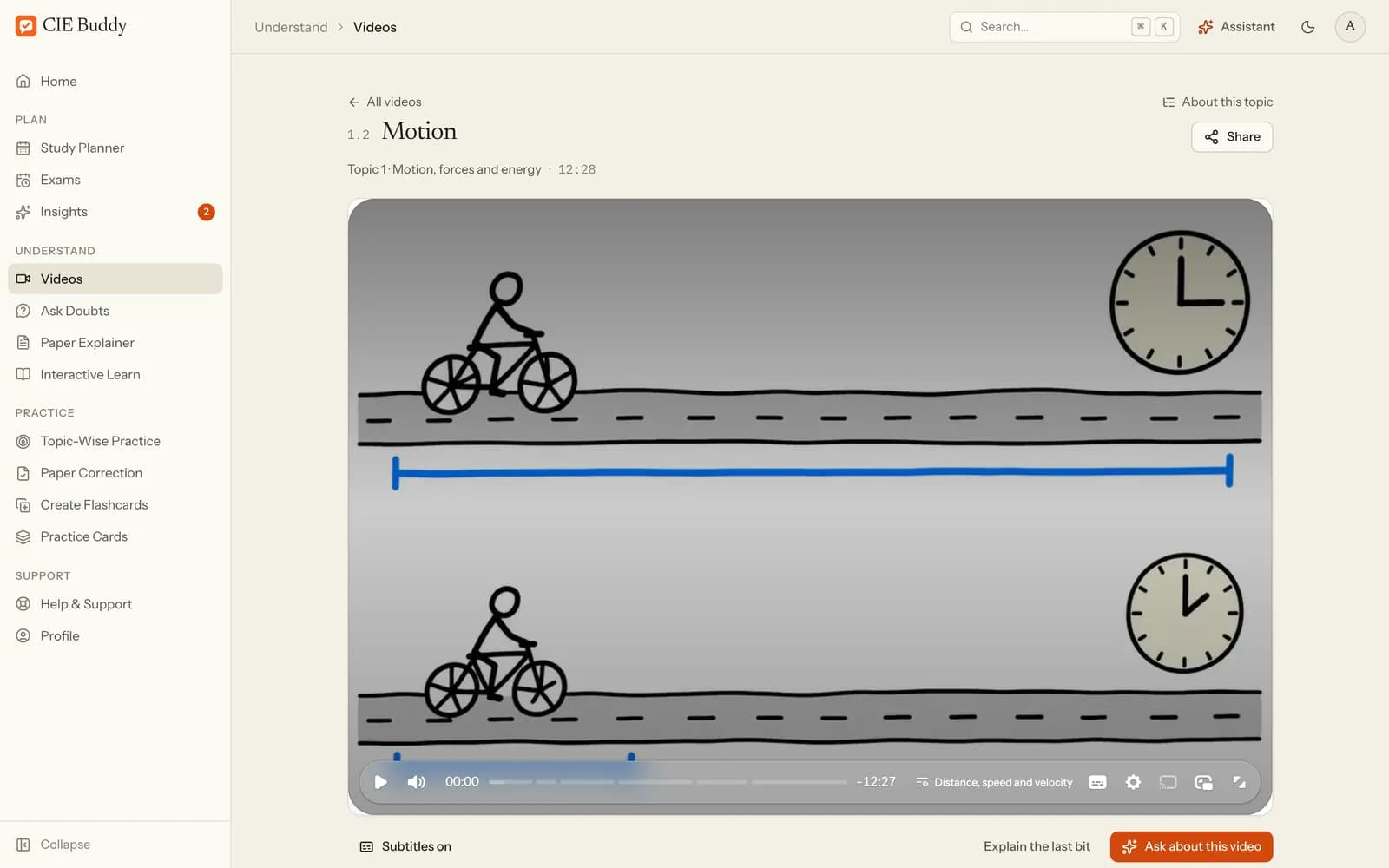
From students
What students say about the videos.
“The videos are really good at explaining.”
IGCSE student, India
Rated helpful
“Currently, I am checking out the Videos and Worksheet generator and so far my feedback is fully positive. I hope this helps.”
IGCSE student, Saudi Arabia
Rated helpful
Video ratings
After each video, students rate it “helpful” or “not really”. So far, every rating has been helpful.
From students of Biology, Physics, Maths, Economics and Accounting.
Every video so far.
Every video, listed by syllabus topic. Open a subject to see what's there. More subjects are being made.
0264IGCSE Business
61 videos · 604 min · every sub-topic in the syllabus
1Understanding business activity
- 1.1.1The nature of business activity8:37
- 1.2.1Types of economic sector7:35
- 1.3.1Enterprise and entrepreneurship11:03
- 1.3.2The methods and problems of measuring business size6:13
- 1.3.3Why some businesses grow and others remain small14:05
- 1.3.4Why some businesses succeed and others fail8:04
- 1.4.1Different types of business organisation15:08
- 1.5.1Business objectives7:28
- 1.5.2The role of stakeholder groups9:38
2People in business
- 2.1.1Recruiting and selecting employees12:21
- 2.1.2Employment contracts and legal controls over employment issues7:53
- 2.1.3Training8:47
- 2.2.1Simple organisational structures11:19
- 2.2.2The functions of management7:33
- 2.2.3Leadership styles9:06
- 2.2.4Why reducing the size of the workforce may be necessary9:04
- 2.2.5The role of trade unions6:11
- 2.3.1Why communication is important10:33
- 2.3.2Communication barriers8:30
- 2.4.1The importance of a well-motivated workforce13:36
- 2.4.2Methods of motivation12:26
3Marketing
- 3.1.1The role of marketing7:17
- 3.1.2Understanding market changes9:55
- 3.1.3Mass markets and niche markets7:50
- 3.1.4Market segmentation7:22
- 3.2.1Methods of market research14:51
- 3.3.1Product14:55
- 3.3.2Price10:58
- 3.3.3Place7:43
- 3.3.4Promotion10:27
- 3.3.5Ecommerce7:23
- 3.3.6Marketing strategy7:34
- 3.3.7Entering new markets in other countries as a method of growth7:40
- 3.4.1Legal controls related to marketing7:04
4Operations management
- 4.1.1Production processes14:20
- 4.1.2The main methods of production9:43
- 4.2.1The use of technology in the production of goods and services8:35
- 4.3.1Methods of sustainable production of goods and services10:40
- 4.4.1Identify and classify costs9:40
- 4.4.2Economies and diseconomies of scale10:08
- 4.4.3Break-even analysis15:21
- 4.5.1Why quality is important and how quality may be achieved8:58
- 4.6.1Main factors which influence location decisions10:58
5Financial information and decisions
- 5.1.1The need for business finance8:11
- 5.1.2The main sources of finance15:03
- 5.2.1The importance of cash and cash flow forecasts11:40
- 5.3.1What is profit and why it is important6:43
- 5.3.2Statement of profit or loss9:04
- 5.4.1The main elements of a statement of financial position11:20
- 5.5.1Profitability10:35
- 5.5.2Liquidity7:57
- 5.5.3Users of accounts10:46
6External influences on business activity
- 6.1.1Business cycle11:02
- 6.1.2Effects of government policy10:15
- 6.2.1The importance of globalisation11:52
- 6.2.2Multinational companies (MNCs)10:51
- 6.2.3External costs and benefits6:37
- 6.2.4Exchange rates9:13
- 6.3.1Environmental issues11:52
- 6.4.1Ethical issues9:45
- 6.5.1The role of pressure groups6:40
0452IGCSE Accounting
28 videos · 373 min · every sub-topic in the syllabus
1The fundamentals of accounting
- 1.1The purpose of accounting8:14
- 1.2The accounting equation8:22
2Sources and recording of data
- 2.1The double entry system of book-keeping14:23
- 2.2Business documents10:54
- 2.3Books of prime entry16:00
3Verification of accounting records
- 3.1The trial balance11:30
- 3.2Corrections of errors13:03
- 3.3Bank reconciliation13:22
- 3.4Control accounts13:06
4Accounting procedures
5Preparation of financial statements
- 5.1Sole traders20:25
- 5.2Partnerships18:41
- 5.3Limited companies16:57
- 5.4Manufacturing accounts13:50
- 5.5Clubs and societies14:29
- 5.6Incomplete records18:08
6Analysis and interpretation
7Accounting concepts and modern practice
- 7.1Accounting concepts13:38
- 7.2Ethical considerations10:06
- 7.3Technology and sustainability11:22
0455IGCSE Economics
36 videos · 407 min · every sub-topic in the syllabus
1The basic economic problem
2The allocation of resources
- 2.1The role of markets in allocating resources7:25
- 2.2Demand9:48
- 2.3Supply9:31
- 2.4Price determination9:55
- 2.5Price changes8:04
- 2.6Price elasticity of demand ped11:51
- 2.7Price elasticity of supply pes9:06
- 2.8Market economic system8:28
- 2.9Market failure12:21
- 2.10Market failure13:25
3Microeconomic decision-makers
- 3.1Money and banking9:56
- 3.2Households8:45
- 3.3Workers16:32
- 3.4Firms11:36
- 3.5Firms and production11:10
- 3.6Firms costs revenue and objectives13:06
- 3.7Types of markets10:50
4Government and the macroeconomy
- 4.1Government macroeconomic intervention11:30
- 4.2Fiscal policy15:23
- 4.3Monetary policy9:43
- 4.4Supply-side policy11:18
- 4.5Economic growth14:31
- 4.6Employment and unemployment12:59
- 4.7Inflation12:09
5Economic development
- 5.1Living standards11:42
- 5.2Poverty10:54
- 5.3Population11:27
- 5.4Differences in economic development between countries12:06
6International trade and globalisation
0580IGCSE Mathematics
72 videos · 614 min · every sub-topic in the syllabus
1Number
- 1.1Types of number8:33
- 1.2Sets10:20
- 1.3Powers and roots5:08
- 1.4Fractions, decimals and percentages9:15
- 1.5Ordering5:01
- 1.6The four operations8:15
- 1.7Indices I7:25
- 1.8Standard form7:36
- 1.9Estimation7:02
- 1.10Limits of accuracy7:34
- 1.11Ratio and proportion7:14
- 1.12Rates7:18
- 1.13Percentages11:18
- 1.14Using a calculator5:00
- 1.15Time7:51
- 1.16Money4:51
- 1.17Extended content only.7:27
- 1.18Extended content only.7:24
2Algebra and graphs
- 2.1Introduction to algebra5:18
- 2.2Algebraic manipulation12:21
- 2.3Algebraic fractions10:41
- 2.4Indices II7:36
- 2.5Equations14:50
- 2.6Inequalities10:57
- 2.7Sequences10:39
- 2.8Proportion8:29
- 2.9Graphs in practical situations10:30
- 2.10Graphs of functions11:56
- 2.11Sketching curves10:51
- 2.12Differentiation10:34
- 2.13Functions10:27
3Coordinate geometry
- 3.1Coordinates4:47
- 3.2Drawing linear graphs4:56
- 3.3Gradient of linear graphs4:41
- 3.4Length and midpoint4:57
- 3.5Equations of linear graphs7:08
- 3.6Parallel lines5:13
- 3.7Perpendicular lines7:35
4Geometry
- 4.1Geometrical terms10:44
- 4.2Geometrical constructions8:13
- 4.3Scale drawings8:14
- 4.4Similarity10:53
- 4.5Symmetry8:22
- 4.6Angles11:48
- 4.7Circle theorems I10:53
- 4.8Circle theorems II9:00
5Mensuration
- 5.1Units of measure7:44
- 5.2Area and perimeter7:31
- 5.3Circles, arcs and sectors8:32
- 5.4Surface area and volume10:57
- 5.5Compound shapes and parts of shapes8:27
6Trigonometry
- 6.1Pythagoras’ theorem5:33
- 6.2Right-angled triangles10:38
- 6.3Exact trigonometric values4:31
- 6.4Trigonometric functions11:18
- 6.5Non-right-angled triangles11:18
- 6.6Pythagoras’ theorem and trigonometry in 3D7:47
7Transformations and vectors
- 7.1Transformations12:01
- 7.2Vectors in two dimensions7:33
- 7.3Magnitude of a vector4:36
- 7.4Vector geometry11:14
8Probability
- 8.1Introduction to probability7:40
- 8.2Relative and expected frequencies8:06
- 8.3Probability of combined events11:05
- 8.4Conditional probability7:50
9Statistics
- 9.1Classifying statistical data4:39
- 9.2Interpreting statistical data8:14
- 9.3Averages and range10:42
- 9.4Statistical charts and diagrams10:52
- 9.5Scatter diagrams7:44
- 9.6Cumulative frequency diagrams10:28
- 9.7Histograms10:13
0610IGCSE Biology
61 videos · 610 min · every sub-topic in the syllabus
1Characteristics and classification of living organisms
2Organisation of the organism
- 2.1Cell structure15:59
- 2.2Size of specimens9:07
3Movement into and out of cells
- 3.1Diffusion10:31
- 3.2Osmosis11:56
- 3.3Active transport6:11
4Biological molecules
- 4.1Biological molecules9:23
5Enzymes
- 5.1Enzymes9:27
6Plant nutrition
- 6.1Photosynthesis11:29
- 6.2Leaf structure7:11
7Human nutrition
- 7.1Diet9:20
- 7.2Digestive system10:26
- 7.3Physical digestion9:38
- 7.4Chemical digestion11:37
- 7.5Absorption7:07
8Transport in plants
- 8.1Xylem and phloem9:38
- 8.2Water uptake9:50
- 8.3Transpiration10:12
- 8.4Translocation8:31
9Transport in animals
- 9.1Circulatory systems7:40
- 9.2Heart14:56
- 9.3Blood vessels10:31
- 9.4Blood9:12
10Diseases and immunity
- 10.1Diseases and immunity12:21
11Gas exchange in humans
- 11.1Gas exchange in humans11:00
12Respiration
- 12.1Respiration8:25
- 12.2Aerobic respiration6:16
- 12.3Anaerobic respiration9:40
13Excretion in humans
- 13.1Excretion in humans10:32
14Coordination and response
- 14.1Coordination and response10:54
- 14.2Sense organs11:54
- 14.3Hormones8:26
- 14.4Homeostasis13:18
- 14.5Tropic responses9:56
15Drugs
- 15.1Drugs7:31
16Reproduction
- 16.1Asexual reproduction7:35
- 16.2Sexual reproduction7:45
- 16.3Sexual reproduction in plants12:00
- 16.4Sexual reproduction in humans11:25
- 16.5Sex hormones in humans9:31
- 16.6Sexually transmitted infections7:41
17Inheritance
- 17.1Chromosomes, genes and proteins11:58
- 17.2Mitosis7:00
- 17.3Meiosis5:48
- 17.4Monohybrid inheritance13:30
18Variation and selection
- 18.1Variation10:23
- 18.2Adaptive features7:24
- 18.3Selection11:19
19Organisms and their environment
- 19.1Energy flow5:46
- 19.2Food chains and food webs13:37
- 19.3Nutrient cycles11:24
- 19.4Populations10:59
20Human influences on ecosystems
- 20.1Food supply7:59
- 20.2Habitat destruction8:21
- 20.3Pollution12:01
- 20.4Conservation12:57
21Biotechnology and genetic modification
- 21.1Biotechnology and genetic modification6:08
- 21.2Biotechnology11:10
- 21.3Genetic modification11:59
0620IGCSE Chemistry
49 videos · 509 min · every sub-topic in the syllabus
1States of matter
- 1.1Solids, liquids and gases10:26
- 1.2Diffusion6:32
2Atoms, elements and compounds
- 2.1Elements, compounds and mixtures6:09
- 2.2Atomic structure and the Periodic Table9:50
- 2.3Isotopes7:51
- 2.4Ions and ionic bonds12:16
- 2.5Simple molecules and covalent bonds12:30
- 2.6Giant covalent structures8:48
- 2.7Metallic bonding5:40
3Stoichiometry
- 3.1Formulae11:13
- 3.2Relative masses of atoms and molecules8:20
- 3.3The mole and the Avogadro constant18:48
4Electrochemistry
- 4.1Electrolysis16:40
- 4.2Hydrogen–oxygen fuel cells7:09
5Chemical energetics
6Chemical reactions
- 6.1Physical and chemical changes5:58
- 6.2Rate of reaction16:41
- 6.3Reversible reactions and equilibrium17:43
- 6.4Redox14:33
7Acids, bases and salts
- 7.1The characteristic properties of acids and bases15:10
- 7.2Oxides6:35
- 7.3Preparation of salts14:12
8The Periodic Table
- 8.1Arrangement of elements10:26
- 8.2Group I properties8:01
- 8.3Group VII properties8:11
- 8.4Transition elements6:25
- 8.5Noble gases4:05
9Metals
- 9.1Properties of metals9:57
- 9.2Uses of metals4:43
- 9.3Alloys and their properties7:00
- 9.4Reactivity series11:11
- 9.5Corrosion of metals7:24
- 9.6Extraction of metals14:18
10Chemistry of the environment
- 10.1Water10:47
- 10.2Fertilisers4:56
- 10.3Air quality and climate18:17
11Organic chemistry
- 11.1Formulae, functional groups and terminology12:32
- 11.2Naming organic compounds12:10
- 11.3Fuels10:01
- 11.4Alkanes6:56
- 11.5Alkenes9:59
- 11.6Alcohols8:24
- 11.7Carboxylic acids8:47
- 11.8Polymers16:57
12Experimental techniques and chemical analysis
- 12.1Experimental design7:59
- 12.2Acid–base titrations6:48
- 12.3Chromatography8:00
- 12.4Separation and purification9:38
- 12.5Identification of ions and gases18:59
0625IGCSE Physics
24 videos · 291 min · every sub-topic in the syllabus
1Motion, forces and energy
- 1.1Physical quantities and measurement techniques9:46
- 1.2Motion12:28
- 1.3Mass and weight6:49
- 1.4Density7:43
- 1.5Forces14:25
- 1.6Momentum8:44
- 1.7Energy, work and power16:00
- 1.8Pressure7:00
2Thermal physics
- 2.1Kinetic particle model of matter13:26
- 2.2Thermal properties and temperature12:58
- 2.3Transfer of thermal energy14:08
3Waves
- 3.1General properties of waves12:07
- 3.2Light14:31
- 3.3Electromagnetic spectrum12:52
- 3.4Sound10:32
4Electricity and magnetism
- 4.1Simple phenomena of magnetism9:52
- 4.2Electrical quantities14:30
- 4.3Electric circuits13:44
- 4.4Electrical safety7:58
- 4.5Electromagnetic effects15:58
5Nuclear physics
- 5.1The nuclear model of the atom9:40
- 5.2Radioactivity16:42
6Space physics
- 6.1Earth and the Solar System13:50
- 6.2Stars and the Universe14:59
9702A Level Physics
11 videos · 157 min · A Level topics 14 to 17
14Temperature
- 14.1Thermal equilibrium8:40
- 14.2Temperature scales15:20
- 14.3Specific heat capacity and specific latent heat16:15
15Ideal gases
- 15.1The mole8:00
- 15.2Equation of state19:11
- 15.3Kinetic theory of gases17:23
16Thermodynamics
- 16.1Internal energy12:00
- 16.2The first law of thermodynamics14:30
17Oscillations
- 17.1Simple harmonic oscillations19:09
- 17.2Energy in simple harmonic motion14:13
- 17.3Damped and forced oscillations, resonance12:01
Only what your level covers
The videos page shows the subjects on your profile, and within each only the topics your level covers. AS students don't see A Level topics, so nothing on the page is outside your course. The A Level Physics videos so far are all A2 topics, so they appear for A Level students only.
After each video
- Practise past-paper questions on the same topic.
- Let Interactive Learn quiz you on the key points.
- Rate the chapter in your planner, so it knows how you feel about it.
- Or go straight to the next sub-topic in the syllabus.
Revision video questions
Which IGCSE subjects have revision videos?
Business (0264), Accounting (0452), Economics (0455), Mathematics (0580), Biology (0610), Chemistry (0620) and Physics (0625). Each has a video for every sub-topic in the syllabus. More subjects are on the way.
How long are the videos?
As long as the topic needs. Each video is dedicated to a single sub-topic and covers it in depth, so you can watch exactly the one you need.
Do the videos follow the Cambridge syllabus?
Yes. There is one video per syllabus sub-topic, in syllabus order, with the same numbers and titles as the syllabus, so you always know where a video fits.
Are there AS and A Level videos?
Yes, for Physics (9702), topics 14 to 17. These are A Level (A2) topics, so they show up for A Level students and are hidden for AS students.
Do the videos have subtitles?
Yes. Every video has English captions you can turn on or off, and a transcript under the player. Click any line of the transcript to jump to that point.
Can I ask a question about a video?
Yes. Ask from under the player and the AI tutor answers knowing which video you're watching and where you are in it. After the video you can also practise past-paper questions on the same topic.
Stuck on a topic? Watch it first.
Make an account with your email or Google, pick your subjects, and start watching.
Start watching